

A Planner's Guide to Throwing an Epic Party: What Party Movies Can Teach Us about Public Space
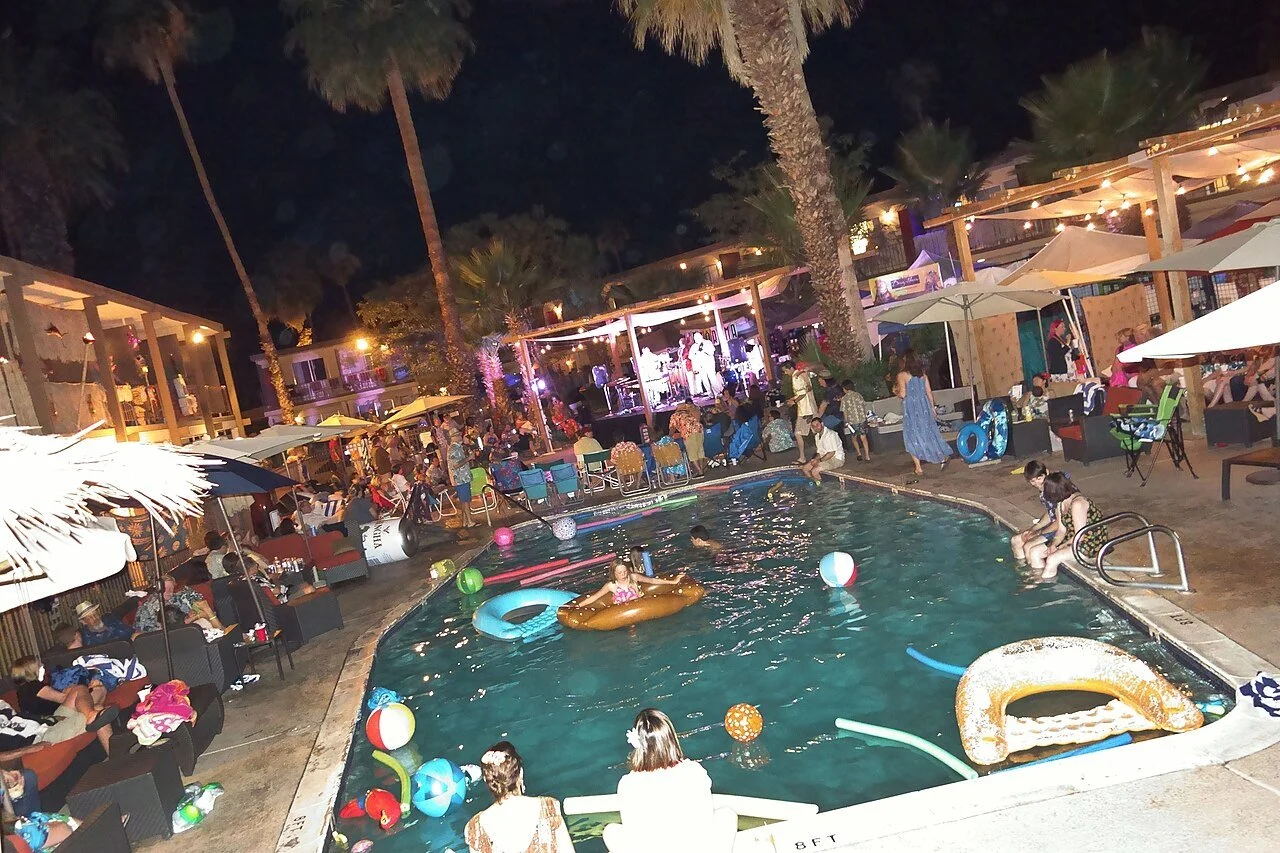
Pool party at night during Tiki Caliente 2014 in Palm Springs, California.
Steven Miller.
Source: Wikimedia Commons. https://commons.wikimedia.org/wiki/File:Pool_Party_at_Night_-_Tiki_Caliente.jpg

Copyright: Creative Commons Attribution 2.0
Introduction
In contemporary global cities, the Night-Time Economy (NTE) has become a desirable asset in attracting the creative class. Some cities have tried to increase their competitiveness by fostering strong nightlife (Yeo & Heng, 2014). This often takes the form of formal festivals and programming, such as Nuit Blanche in Montreal, or by encouraging commercial bars, clubs, and entertainment districts. But what, by creating formal, commercial NTEs, have planners missed about the nature of partying?
Over the past month, I have made it a goal to watch every party movie. While sitting back and enjoying various titles ranging from Party Monster (2003) to Project X (2012), I asked myself what the point of partying was, both in the plot and in the broader moral messaging of the movies. Three main themes emerged:
Partying as a sin,
Partying as counter-culture,
Partying as public space.
In this YIMBY, I explore these themes and relate them to planning, asking what urban forms best support an epic party.
Partying as a sin
In Party Girl (1995), the plot follows a structure common to many party movies: the main character(s) embark on an epic journey of drinking and partying, only to learn that their hedonism was holding them back the entire time. In Party Girl, the protagonist, Mary, a fashionable and messy 20-something living in New York City, realizes that her obsession with partying is an obstacle to her self-improvement and pursues a life as a librarian instead. I am reminded of a quote from my favourite musical, Chicago: “Mrs. Hart feels that it was the tragic combination of liquor and jazz which led to her downfall.” These stories tell a cautionary tale about partying, positioning it as a dangerous pursuit. The “sin” of partying compels governments to regulate parties and nightlife tightly. NTEs serve as a substitute for the “jazz and liquor” of unorganized social gatherings – bars and nightclubs are organized, safe, and predictable.
Partying as counter-culture
While party movies frequently portray partying as a vice, they usually also cannot help but portray the joy. In media, and indeed in real life as well, parties can serve as sites of counter-cultures: safe spaces for those who are (or feel) marginalized, whether that be queer club kids, young women, or (unfortunately, more often than not) lame men who feel uncool. Movies like Project X (2012) illustrate the transformative nature of parties as spaces where societal power structures are rewritten, and communities grow closer. In Project X, three uncool dorks set out on a mission to throw the most epic party ever. While the party itself gets out of hand, a seemingly cautionary tale of the “sin” of partying, the conclusion of the film shows our protagonist having climbed the social ladder, from the bottom to the top, and fostered a strong sense of community at their school in the process. The moral of the story is that parties, while chaotic, can lead to social change.
Parties disrupt quotidian modern life and create spaces where the voiceless can become shamelessly loud. Reinforcing the perception of party spaces as counter-cultural, and focusing specifically on underground dance clubs, Dr. Richard Anderson from the University of Liverpool describes underground club culture as “a form of resistance, a countercultural antithesis to mainstream, and a social imaginary” (Anderson, 2024). He continues, describing a “collective intention toward community, often lacking in daily life” that exists in party spaces (Anderson, 2024). The inherently informal nature of party spaces allows them to become inclusive spaces.
Partying as public space
A house party occurs when, to use terms coined by Ray Oldenburg (Oldenburg, 1989), a first place becomes a third place. Parties, by definition, cannot be a solitary pursuit. They require people to gather to create a sense of community. Thus, a good party requires a good public space, places where citizens can come together and create social capital.
Beyond being public, good party spaces should also be informal and welcoming. A great example is Drury Street in Dublin, although it would certainly be an exaggeration to call what happens there “partying.” A recently pedestrianized street in Central Dublin, it has attracted large numbers of people sitting on the curb, some consuming alcohol, others simply people-watching. The Irish Times claims that “Among a certain age group in Dublin, it is more desirable to sit on the pavement of Drury Street than on a barstool elsewhere” (Browne, 2026). What is notable about this example is that (beyond removing cars and its proximity to pubs) no formal amenities or programming were required to create a vibrant public space. It’s not benches that draw people to Drury Street. Instead, the informality of the public space attracts so many people to participate in the life of the street.
Critics of Drury Street view its informality as a nuisance; they point to crowds blocking business entrances and the dangers of unregulated public alcohol consumption. In response, the City Council has begun discouraging people from sitting on the curb. This has sparked a heated debate about who owns the street and what power the city has to regulate behaviour in public spaces. At the heart of the debate, I think, is a real tension between the desire for more informal third spaces and a desire for order and efficiency in the city. Put another way, what good are people hanging out if they are not going to buy anything?
Another interesting case study is discussed in “An (Extra)ordinary Night Out: Urban Informality, Social Sustainability and the Night-time Economy,” an article by Su-Jan Yeo and Chye Kiang Heng (2014). The authors analyze daily routines in Toa Payoh Central, a vibrant, informal public space in Singapore's heartlands, and compare them with the formal, commercial NTE of the Downtown Core. Yeo and Heng celebrate Toa Payoh Central for its ability to draw late-night crowds, without the regulated sites of capitalistic consumption that have become synonymous with night-life in cities worldwide. The secret to Toa Payoh Central’s success? A relaxed, inviting environment, a strong culture of street life and inclusive public spaces that attract diverse groups of people (Yeo & Heng, 2014).
Conclusion
Modern cities attempt to both attract and control partying. They do this through tight regulation and suppression of informal party spaces, and by encouraging capitalist sites of consumption such as bars and nightclubs. Unfortunately, bars and nightclubs are often not the most inclusive and do not challenge mainstream culture or inspire the same community-building as informal public spaces.
This YIMBY acknowledges that partying is not all sunshine and butterflies. While parties can genuinely be disruptive, we need to ask what we lose if we let all our night-time third spaces become tightly controlled and consumerist. There are parallels between being a good party host and a good planner: both should create comfortable and inviting spaces where people can connect, build community, critique the status quo, foster creativity, and have fun! It is highly possible that planners may be able to achieve these goals by doing the scariest thing imaginable: letting go of control.
P.S.
Right after I wrote this YIMBY, Uytae Lee, my favourite urban planning YouTuber, released a video covering the exact same topic. Great minds… His video complements many of the ideas discussed above. In particular, I think he has a super valuable perspective on clubs as places of experimentation and social change. The video is definitely worth a watch. I just need everyone to know that I wrote this first.
Written by GAPSS VP Internal David Ivanchikov
References
Anderson, R. (2024). ‘It felt very underground’: Uncovering the characteristics and meanings of the underground within Liverpool’s club culture scenes. DIY, Alternative Cultures & Society, 2(3), 322–336. https://doi.org/10.1177/27538702241290333
Browne, N. (2026, May 16). ‘Way more than just drinking outside’: Young people on reclaiming Dublin’s Drury Street. The Irish Times. https://www.irishtimes.com/life-style/2026/05/16/curbing-outdoor-drinking-on-drury-street-a-war-on-the-young/
Oldenburg, R. (1989). The Great Good Place : cafés, coffee shops, community centers
beauty parlors, general stores, bars, hangouts, and how they get you through the day (1st ed.). Paragon House.
Yeo, S.-J., & Heng, C. K. (2014). An (Extra)ordinary Night Out: Urban Informality, Social Sustainability and the Night-time Economy. Urban Studies (Edinburgh, Scotland), 51(4), 712–726. https://doi.org/10.1177/0042098013489743