

Public Art Sucks
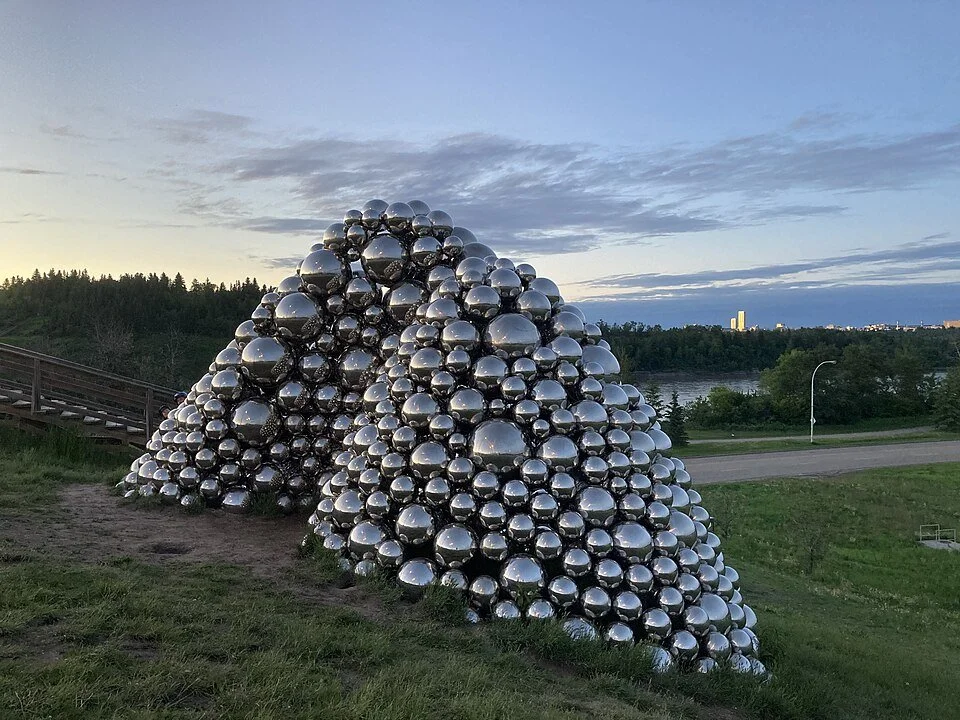
Description: The Talus Dome, located in Edmonton, Alberta, at dusk in 2020.
Date: 16 June, 2020
Author: Talusdome
Copyright: Creative Commons Attribution-Share Alike 4.0
Source: Wikimedia Commons. https://commons.wikimedia.org/wiki/File:Talus_dome_2020.jpg

Public art sucks
The City of Edmonton claims that its public art policies “support the acquisition of public art as a way of enhancing quality of life and livability for its residents” (City of Edmonton). Let me ask you, dearest reader, a simple question: does the Talus Dome enhance your quality of life? Does the Talus Dome make Edmonton a more livable place?
Let’s take this a step further: Does the Talus Dome make a freeway interchange a pleasant place to be? Of course not. How many times have you walked past the Dove of Peace in Gallagher Park without realizing it was public art? If you’re anything like me, it’s more times than you can count.
Public art can be easy to clown on. We all love to hate that circle above the highway in Calgary titled “Travelling Light.” The City of Calgary writes that “Travelling Light is a bold and innovative artwork, intended to capture the dynamics of Calgary on the move and create a lasting impression for all who experience it” (City of Calgary). I would argue that a big blue metal ring doesn’t reflect the “dynamics of Calgary,” but I guess art is subjective.
Another recent example in Saskatoon has rocked the city and sparked passionate conversations about public art. Modern Erratics, a series of plastic boulders, cost $310,000, and some residents are struggling to see a positive impact (Warren 2026).
Arts matter
My intention is not to add to the cacophony of voices trying to devalue the arts. Arts matter. I won’t get into it, but I encourage you to read more about it on the Edmonton Arts Council’s website (Edmonton Arts Council). They say it better than I ever could.
The title of this blog post is clickbait. I plead guilty. I aim to critique the policies that create what I find, frankly, a mockery of what public art can be. Yes, public art can be meaningful. I implore you to resist the sweet temptation of false dichotomies.
How did we get here?
Most Canadian cities have policies that require projects exceeding a certain financial threshold to allocate part of their budget to public art. The City of Edmonton’s version, Public Art to Enhance Edmonton’s Public Realm, requires large capital projects to spend 1% of their cost on public art. The City of Vancouver takes a different approach, requiring qualifying rezonings and developments of 100,000 sq. ft./9,290 m2 or greater to spend $1.98 per buildable square foot (the exact number is adjusted annually) (City of Vancouver 2026).
Both of these policies claim to improve the quality of the public realm. In this regard, I don’t think they’ve succeeded. Those sculptures atop the Valley Line LRT stations don’t make my commute any more enjoyable. The Dove of Peace doesn’t make me want to spend more time in Gallagher Park. Urban design offers many solutions to improve the public realm that don’t rely on ambiguous sculptures. For example, greenery, lighting, seating, pedestrian infrastructure, and dense urban form all improve the public realm. If a city is an unpleasant place to be, a pile of shiny metal balls won’t fix that.
Municipal governments should ask themselves how they could spend that money better. Maybe they could spend some of it on actually improving the public realm.
Spaces for artists, not public art
Vancouver has seen a massive loss of artists’ studios in recent decades (CBC News 2023). The culprit: a loss of affordable commercial and industrial land that artists rely on. Having a public art policy that contributes to unaffordability, drives up construction costs, and displaces artists during rezoning is ironic.
What if art was truly public?
The current approach to public art is born from a misunderstanding of art itself. These policies position art as something inherently expensive, created by expert artists, and static. I believe that, as creative beings, we are all artists. Art communicates ideas and perspectives and can push the status quo. Creativity is essential to healthy communities, especially when we understand art as an ongoing, collective practice. In contrast, public art is often individualistic, disconnected from the surrounding community, and doesn’t inspire further creativity.
It is also worth noting that current policies make the mistake of measuring art’s worth by its price tag, an idea I suspect governments have borrowed from the exclusive world of fine art where art is used as capital, to get unfair tax breaks, and to store the wealth of the ultra-wealthy (a larger discussion for another time). I don’t mean to suggest that public art functions within the problematic world of fine art, but just that the underlying ideologies are the same: art as valuable simply because it is expensive.
Effective public art should democratize art and encourage citizens to participate in artmaking. In the simplest sense, this means reducing barriers to art. What if 1% of capital projects’ cost went to community arts organizations instead of public art? What if we invested in studio spaces? What if we invested in affordability, ensuring that our cities are inclusive places that can be sites of experimentation? If we really care about art for the public, we need to demand better policies.
Perhaps the city, as something we’ve created collectively, is, itself, public art.
Conclusion
Art and urban planning can be a difficult conversation. Art is subjective, constantly evolving, and hard to define. Planning, on the other hand, requires a certain level of objectivity to function; it’s hard to regulate, plan, or write policies about something you can’t define. Public art sits at the uncomfortable intersection of cities and art, two impossibly complex topics.
I’m not pretending to have solved the innate subjectivity of this topic, but my hope is that I’ve encouraged you, dearest reader, to think critically about the role of art in the city. Art matters, yes, but that can’t be the end of the conversation. Not all art is equal. Planning has a role in making art public. A good place to start might be to quit making “public art.”
Written by GAPSS VP Internal David Ivanchikov
References
CBC News (April 18, 2023). Vancouver risks becoming a ‘city without art’ as studio spaces become harder to find, artists say.
https://www.cbc.ca/news/canada/british-columbia/vancouver-risks-becoming-a-city-without-art-as-studio-spaces-become-harder-to-find-artists-say-1.6813142
City of Calgary. Travelling Light - Public Artwork. Retrieved October 16, 2026.
https://www.calgary.ca/arts-culture/public-art/96-avenue-ne.html
City of Edmonton. Edmonton’s Public Art. Retrieved October 16, 2026.
https://www.edmonton.ca/city_government/edmonton_archives/edmontons-public-art
City of Vancouver (Last amended September 30, 2026). Policy: Public Art for Rezonings.
https://guidelines.vancouver.ca/policy-public-art-for-rezonings.pdf
Edmonton Arts Council. Why the arts matter. Retrieved October 16, 2026.
https://www.edmontonarts.ca/about/research-impact/why-the-arts-matter
Warren, J. (Aug 6, 2026). Rock ‘n’ roll: Some mock, others defend public art project that put 3 plastic boulders around Saskatoon. CBC News.
https://www.cbc.ca/news/canada/saskatchewan/some-mock-others-defend-public-art-project-that-put-plastic-boulders-around-saskatoon-9.7297717