

One Olympics, Eight Towns: Planning the Most Geographically Dispersed Winter Games in History
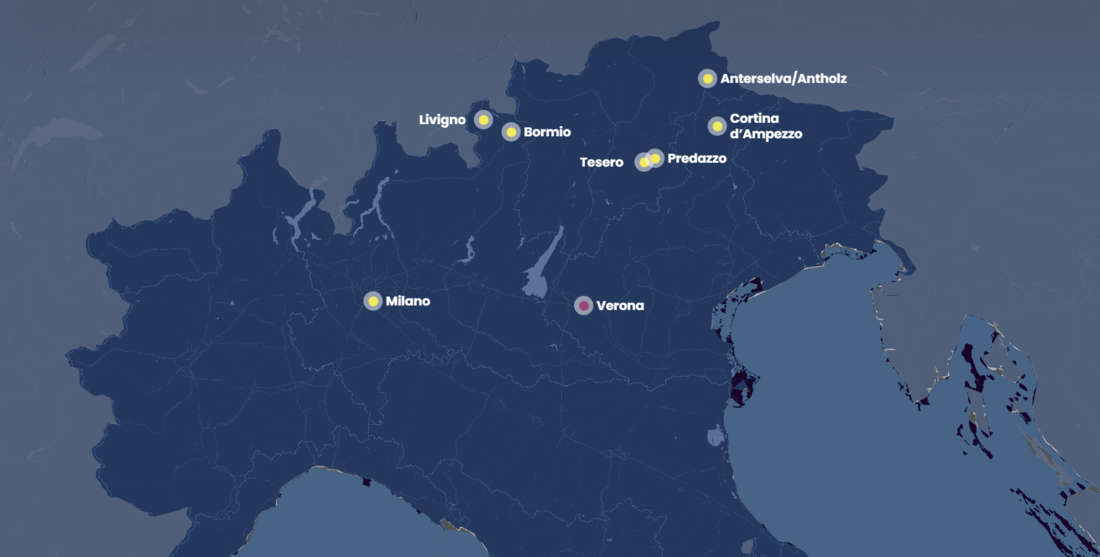
What if an Olympic Games did not belong to one city, but to an entire region? Milano Cortina 2026 marked the first Olympics officially co-hosted by two cities, with events taking place across Northern Italy. The Games stretched across roughly 22,000 square kilometres, making them the most geographically dispersed Winter Olympics in history (Brady, 2026; Stevenson, 2026). Instead of one city acting as the host, the competitions were held across Milan, Cortina d’Ampezzo, and multiple alpine hubs, totalling eight locations! This new structure followed the International Olympic Committee’s post-2020 reforms, which encouraged hosts to reuse existing venues and limit costly new construction (Stevenson, 2026). In theory, the approach reduced environmental footprint and distributed economic benefits across multiple communities. In practice, it produced a Games without a clear host city, and therefore without a central anchor for athletes and spectators. (Stevenson, 2026).
Picture: https://www.europe-consommateurs.eu/en/travelling-motor-vehicles/olympic-and-paralympic-games/milano-cortina-2026.html
@Leaflet | @OpenStreetMap
Mobility became extremely important for this event. Visiting all eight Olympic hubs required travelling about 850 kilometres (Stevenson, 2026). Rail served as the primary way to get around, with shuttle buses linking stations and park-and-ride lots directly to venues. Cars were generally restricted near competition sites, particularly in alpine towns like Cortina (Stevenson, 2026). Milan’s metro, tram, and bus systems also extended service hours to absorb Olympic demand (Stevenson, 2026). From a planning lens, this model is ambitious, because it forced everyone to rely on multiple different transit networks rather than one centralized infrastructure. It also meant athletes were separated across clusters, and even national teams had to disperse support services (Brady, 2026). This meant that the traditional Olympic Village experience was no longer.
Instead of one village, there were multiple accommodation models. In Cortina, up to 1,400 athletes stayed in temporary modular units that were set to be redistributed across Italy after the Games (Nudelman, 2026). Meanwhile, we can look at Cortina’s permanent housing market which remains severely constrained. Limited buildable land and strict regulations keep supply tight, with average prices reaching equivalent to $20,727 CAD per square metre, but exposure from the Olympics is unlikely to fundamentally alter this dynamic (Nudelman, 2026). This is where we get into the planning debate. Concentrated Games often leave behind expensive, underused infrastructure, while this new idea of dispersed Games avoided that risk while sacrificing cohesion.
Looking ahead, Milano Cortina 2026 may not be an isolated experiment. The 2030 Winter Olympics will be in the French Alps, where events are planned across multiple Alpine departments rather than within a single host city (International Olympic Committee [IOC], 2023a). However, not all upcoming Olympics are following this new model. The 2034 Winter Olympics will be in Salt Lake City, Utah, returning to the traditional host-city concept. (IOC, 2023b). Additionally, the 2028 Summer Olympics in Los Angeles will be centred primarily within the L.A. metropolitan region (IOC, 2017), and the 2032 Summer Olympics in Brisbane are similarly structured around a primary host city and its surrounding region (IOC, 2021).
Milano Cortina 2026 therefore represents neither a complete break from tradition, nor a guaranteed blueprint for the future. It demonstrated that mega-events like the Olympics can be organized regionally rather than be centralized urban spectacles. As financial pressures and sustainability concerns continue to shape how these global events are planned, the real legacy of specific Games may not be about fancy new landmarks, but in proving that reuse, and regional balance can define an Olympic model just as powerfully as a single city. And if you ask one of us planners or geographers, that might be the most impressive podium finish of all. ;)
Written by Media Committee Member Logan W.
References
Brady, R. (2026, January 27). Canadian Olympic Committee works to navigate a very spread out Winter Games in Italy. The Globe and Mail. 
International Olympic Committee. (2017). Olympic Games Los Angeles 2028. https://olympics.com/ioc/los-angeles-2028
International Olympic Committee. (2021). Brisbane 2032 Olympic Games. https://olympics.com/ioc/brisbane-2032
International Olympic Committee. (2023a). French Alps 2030 Olympic and Paralympic Winter Games. https://olympics.com/ioc/french-alps-2030
International Olympic Committee. (2023b). Salt Lake City-Utah 2034 Olympic and Paralympic Winter Games. https://olympics.com/ioc/salt-lake-city-utah-2034
Nudelman, G. (2026, February 14). Even with Olympic buzz, Cortina d’Ampezzo’s housing market remains tight. Mansion Global. 
Stevenson, V. (2026, February 5). Milan. Cortina. Antholz-Anterselva? Athletes, fans wrap their heads around wide spread of 2026 Olympic venues. CBC News.