

Written by Leah Song
This summer I had the chance to visit Gangnam, Seoul, South Korea and was quite intrigued by the hidden juxtaposition of wealth and poverty. In the middle of Gangnam, the symbol of affluence, economic success, Korea's first new town, to find illegal settlements.. was like seeing a lie become truth.
But really, why did this happen, and what happens to existing residents once redevelopment happens? Who had to sacrifice their homes and what happened to them?
In order to do so, I must introduce a Korean text, ‘A Little Ball Launched by a Dwarf'. This is a story about a family living in ‘Happiness’ district of ‘Paradise’ ward. Residents that live here “smell” of poverty but are hard workers yet to find themselves in unfortunate circumstances. Here a marginalized family receives an eviction notice ordering their home torn down for redevelopment. Along comes a voucher for a new apartment as replacement- which no resident is able to afford. Property speculators swarm the neighborhood to buy the residents land deeds along with the apartment occupancy rights. Ironically, all the residents are torn from the “Happiness” district, away from “Paradise” ward and left to tend for survival. Homes lost, with almost no money in hand, the hard working residents are faced with fear and apathy. What next? Where to? The entrapment drives the father to retreat into his dream of launching a small iron ball into the sky.
“Kim Bool-yee starts to lose his mind after he hears from a neighbor that if someone works hard, abides the law, prays faithfully, and still finds an unfortunate life, he should leave this dead, indifferent world and move to the moon. Taking these words literally, he begins to dream of life on the moon, and whenever something goes wrong, he goes outside and shoots a small iron ball high into the air. Even though he sees all of his balls fall back to the earth, he keeps shooting and dreaming. One day he climbs up on the chimney of the factory where he had once worked in order to stand closer to the moon. There he makes a last but his most passionate try to launch his dream up to the moon, but this time, like all of his past iron balls, he falls down to the earth—and dies.” ( NASRULLAH MAMBROL analysis of Cho Se Hui’s The Dwarf)
You can read the full summary here, but this story of a family navigating losing their home left a huge impression on me of the many forced relocations during Seoul’s modernization projects– especially in preparation for the 1988 Seoul Olympics. The novel's fictional setting is a reflection to Korea’s real world dal-dong-naes (moon villages) where much of the poor had been kicked out of the city's core and settled for higher areas, mostly at the city's mountain slopes that were closest to the moon. If you lay down, it was almost as though you could reach for the stars and moon; thus the naming ‘moon village’.
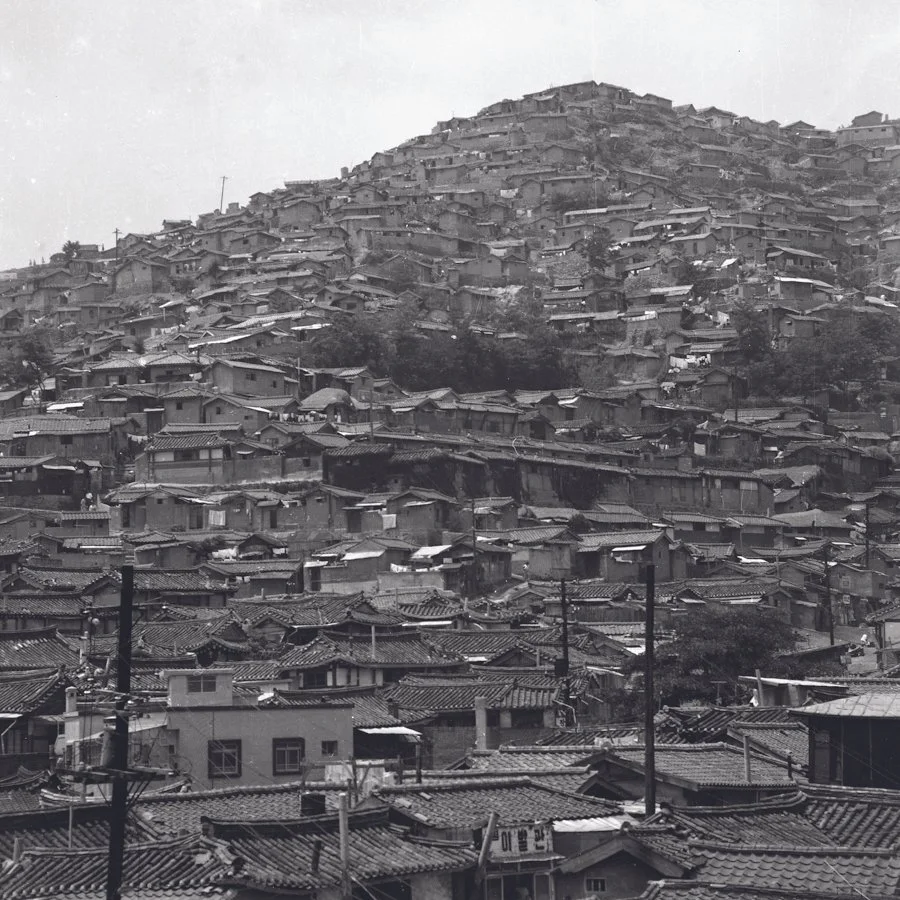
Image credit: Seoul Museum of History, “View of Shanty Houses in Cheonyeon-dong (June 20, 1968),” June 20, 1968. Seoul History Archive, Archive No. H-TRNS-56089-411. Korea Open Government License Type 1 (Attribution).
With demolitions planned for dal-dong-naes, the Korean government's solution was the Gwangu Housing Complex approximately 20-25 km southeast of central Seoul. To this point there was not much suburbanization in Seoul. Due to South Korea's export based economic growth that focused on industrial infrastructure there had been less capacity for urban infrastructure. Regardless, beginning in 1969, households were relocated to this complex where the government allocated residential plots. The Seoul Governmet stated that ⅔ of their purchased land would be sold to residents and profit would be directed to public infrastructure. However, development was still in progress when the move started where road constructions were only completed 50% and educational facilities, sewage, electricity did not exist at all. This left 30.4 % of residents to live in tents or plywood shacks (pan-ja-jip). Only 5% employed locally as Gwangju was considered very far from Seoul and yet only six buses to Seoul were scheduled despite it being where the majority of people had jobs. With little to no income, living conditions only got worse.
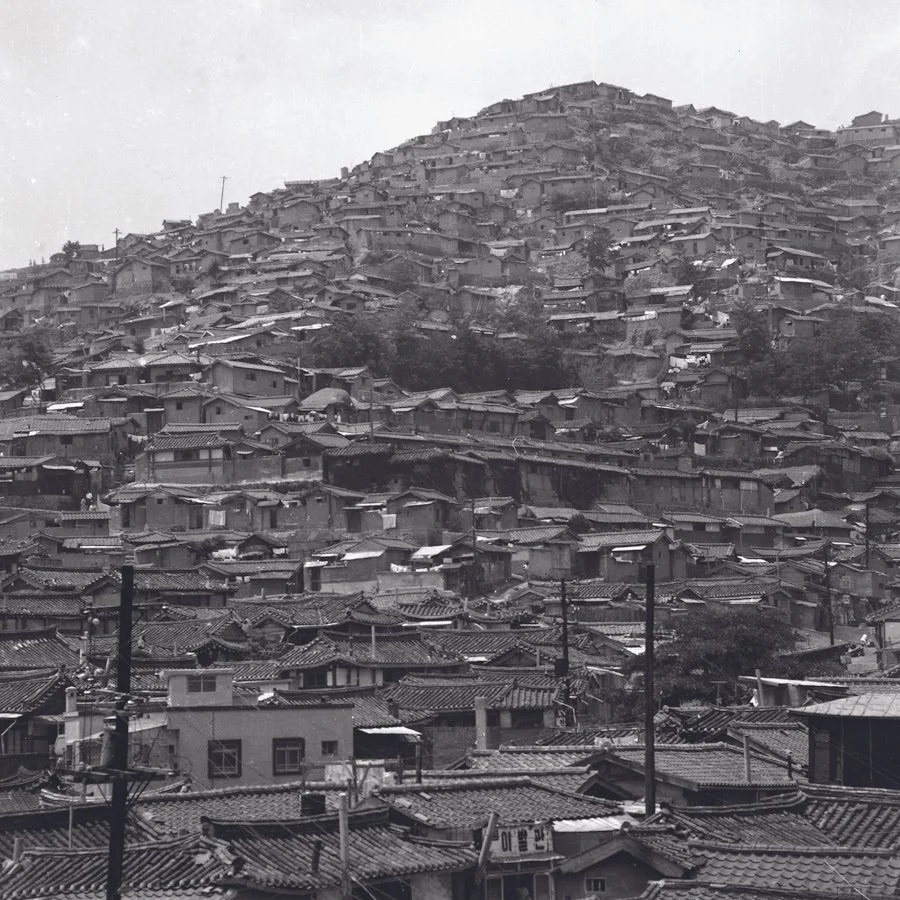
Image credit: Seoul Museum of History, “August 10 Gwangju Housing Complex Incident,” August 10, 1971, Archive No. H-TRNS-54414-741. Licensed under Korea Open Government License Type 1 (Attribution).
Unsurprisingly these conditions pushed residents and sparked the 1971 Gwangju Housing Complex protest against forced displacement. The Residents Committee became the Struggle Committee and eventually led to the Korean government's shift of housing policy from urban development to new towns prelude to Gangnam, the first Korean new town.
These villages that were and still are very high, seemingly making you think you can reach for the moon – only for gravity to pull you back down. As Seoul continues to rebuild and redevelop, the story of ‘A Little Ball Launched by a Dwarf' seemed quite relevant to me. You can work hard, but will you be able to save your home? The odds were most likely not in your favour if you were poor, and living in a dal- dong- nae before the 80s in South Korea.
Written by Leah Song
Works Cited
Analysis of Cho Se-hui’s The Dwarf – Literary Theory and Criticism
Sonn, Jung Won. The Prehistory of Korean Suburban New Towns. Seoul National University, n.d. PowerPoint slides.
1st Image credit: Seoul Museum of History, “View of Shanty Houses in Cheonyeon-dong (June 20, 1968),” June 20, 1968. Seoul History Archive, Archive No. H-TRNS-56089-411. Korea Open Government License Type 1 (Attribution).
2nd Image credit: Seoul Museum of History, “August 10 Gwangju Housing Complex Incident,” August 10, 1971, Archive No. H-TRNS-54414-741. Licensed under Korea Open Government License Type 1 (Attribution).