

‘Free’ Parking Is Very Costly
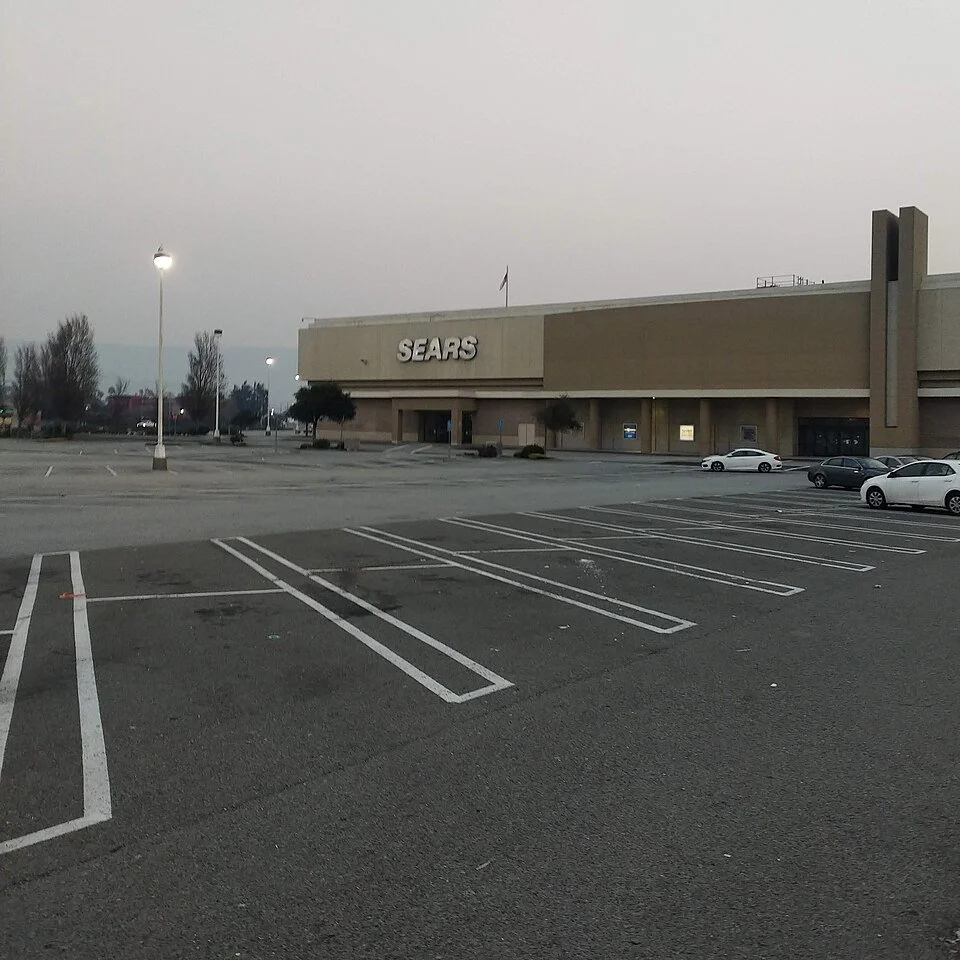
Image title: ‘Parking lot and Sears store’ , image sourced from Wikimedia Commons.
Original image source:
https://commons.wikimedia.org/w/index.php?search=Parking+lot&title=Special%3AMediaSearch&type=image
Credit to: FuriousYogi
Over the last century, driving has become a national favourite pastime in both Canada and the United States. We drive to work, to see our friends, to get groceries, and sometimes even just out of boredom. Parking fees are an annoying aside to the ‘privilege’ of being able to drive. We often get annoyed, try to skip out on paying, or find somewhere else to park when there’s a fee, but many take for granted that the majority of the time parking is totally free. Or at least, appears to be free. In reality, this free parking has a much greater cost than anyone accounts for. Way more than $2-3 per hour. The sacrifices we collectively make in order to provide drivers somewhere to store their personal property are borne by everybody, including those who cannot or choose not to drive.
If there’s any city that knows how to build a car park, it’s Edmonton. Did you know that West Edmonton Mall holds the Guinness World Record for the largest parking lot in the world? It has 20,000 parking spaces and 10,000 additional overflow spots (Guinness World Records, 1999).
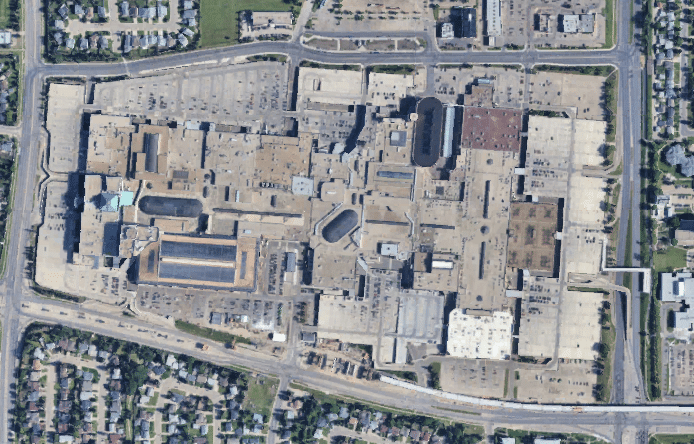
West Edmonton Mall seen from above, image sourced from Google Maps at an unknown date
All 30,000 spaces are generally completely free to use for shoppers and employees! What a steal! Well, not exactly. Given the mall’s total footprint is over 5.3 million square feet (WEM, 2026), and 3.8 million square feet (350,000m2) is the gross leasable space (West Edmonton Mall, 2026), we can make an assumption that the majority of the remaining space is comprised of the parking lot. For simplicity's sake, we will assume all 1.5 million square feet is parking.
Here’s where you must ask yourself an important question: imagine a world with significantly less cars, or one where everyone took transit to the mall. What else could be done with 1.5 million square feet? According to Urban Toronto, a typical residential condo tower has a tower plate of 8000 square feet (Terpestra, 2022). The tower plate refers to the amount of ground space the building occupies. This means you could theoretically fit 187 mid-rise condo towers in the space the WEM parking lot occupies. Additional housing of this magnitude could provide thousands of units for low income residents in desperate need of rent relief, or just add to the overall supply of housing, which is generally correlated with housing affordability.
There are an estimated 3.2-4.4 parking spots for every vehicle in this country, totalling 71-97 million parking spaces (The Transition Accelerator, 2021). All this asphalt puts a tremendous strain on the environment and the world we experience everyday. Asphalt manufacturing creates lots of emissions: it must be transported, mixed and poured. It doesn’t stop there, though; that land cannot be used for plants, trees, or anything else beneficial to our natural world. On top of that, all of this ‘free’ parking encourages more driving which further emits CO2 and wrecks our air quality.
We pay the price to park in many more subtle ways as well. Large parking lots amplify the ‘urban heat island effect’ making summer days feel much hotter than they already do by trapping heat and providing no shade. On a hot sunny day, a paved surface can be 27-50C hotter than the air temperature (Climate Atlas of Canada, 2009). The effect is most noticeable in the evening, as cities are on average 12 degrees hotter after a hot day than a rural, vegetated countryside would be. This kind of brutal heat can be lethal for the elderly, children, or those with previous health conditions.
Finally, the financial cost we all pay (both directly and indirectly) for this sea of parking is staggering. Direct costs consider that the cost to build and maintain the lot is baked into the prices of everyday items. Whether this be at grocery stores, restaurants or your rent. Until recently, all cities in Canada had minimum parking rules that required housing developers to include a set amount of parking spots per resident, driving up building costs (passed onto you). Edmonton was one of the first cities to repeal this in 2020. Minimum parking requirements also lead to higher property taxes by reducing how much housing can be built, and increasing city costs to maintain an ever expanding road network. If taxes don’t increase, services get cut.
Taking all this into consideration, you might want to think twice next time you jump for joy because you found a ‘free’ parking spot. Consider that after accounting for the societal costs and the hidden costs, that spot becomes very costly. Our obsession with cars and having an easy place to store them is not just an environmental or financial issue, it is a major inequity problem. Everyone pays for parking, even if you’ve never driven a car in your life. Not only that, animals also suffer from habitat destruction that they did not vote for. By choosing to walk, bike, or take transit, not only are you reducing your emissions, you’re also making a statement about the kind of city you want to live in.
Written by GAPSS Media Committee Member Nathanial Dosman
References
1. Records, G. W. (1999, February 2). Largest car park. Guinness World Records.
https://www.guinnessworldrecords.com/world-records/largest-car-park
2. About West Edmonton Mall. (2026). Www.Wem.Ca. https://www.wem.ca/about/
3. West Edmonton Mall. (2026). Thecanadianencyclopedia.Ca.
https://thecanadianencyclopedia.ca/en/article/west-edmonton-mall
4. Terpstra, N. (2022). Explainer: Residential vs office tower floor-plates | UrbanToronto.
Urban_Toronto.
https://urbantoronto.ca/news/2022/04/explainer-residential-vs-office-tower-floor-plates.47640
5. Communications, T. (2021, October 12). What if our cities only needed a fraction of their parking spaces? The Transition Accelerator.
https://transitionaccelerator.ca/news-and-insights/what-if-our-cities-only-needed-a-fraction-of-their-parking-spaces/
6. Climate Atlas of Canada. (2009). Urban heat island effect. Climateatlas.Ca.