

Whyte Avenue Deserves Rail: Rethinking the Scrapped LRT Proposal
Every time I ride the 4 or the 8 bus down Whyte Avenue, I’m reminded of how vehicle-centric this corridor still is. Buses squeeze between turning vehicles, patio buildouts and curbside parking, and it’s obvious this street struggles to function as an urban main street. Thinking about the cancelled Whyte Avenue LRT isn’t me being nostalgic for a lost plan, but rather asking whether the city passed on a huge transformational opportunity.
The 2018 Centre LRT Study identified Whyte as the preferred east-west alignment, while openly acknowledging trade-offs: parking removal, tree impacts, median changes and reduced vehicle space would all need to be managed (City of Edmonton, 2018). Ultimately, the City Plan ended up eliminating this line entirely. Planners instead moved toward an urban structure based on one expanded downtown plus several “mini-downtowns” and over twenty town centres (Stolte, 2019). In this new model, Whyte Avenue received no plans for an LRT line. The City’s transit analysis concluded that a rapid bus corridor could deliver about ninety percent of LRT’s benefits at lower cost and with less disruption (Stolte, 2019).
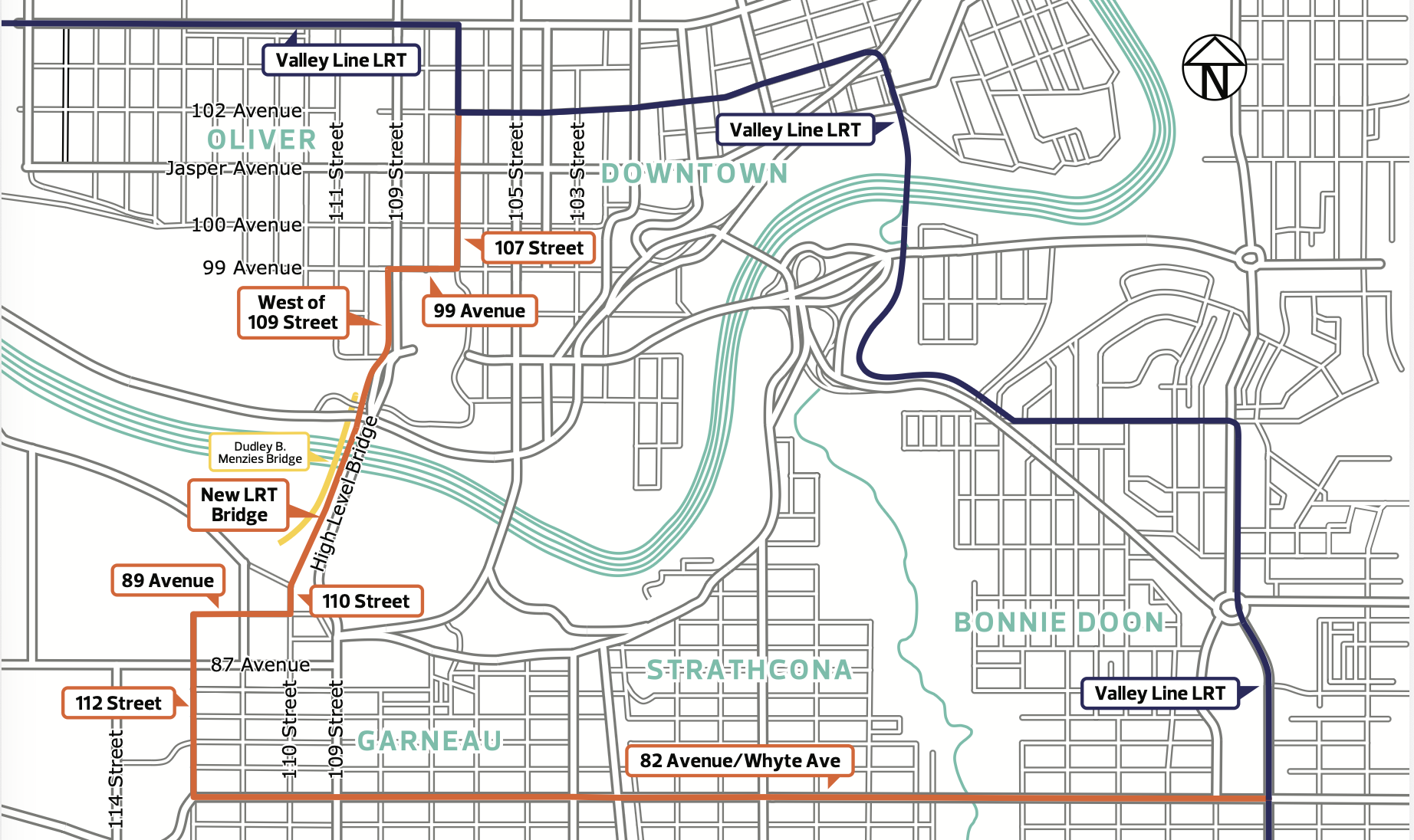
(City of Edmonton, 2018)
However, my lived experience on Whyte tells a different story. Many of my friends who are not planning and transit nerds like me hesitate to take the bus out of fear or confusion, but feel completely comfortable using the LRT. Rail is legible and intuitive in ways buses often aren’t. So if Edmonton actually wants meaningful mode shift, the “ninety percent” claim feels optimistic. A Whyte LRT would likely outperform bus priority simply because more people would choose it.
This new LRT line is still completely possible. The High Level Bridge was ruled out because it cannot support LRT loads even with extensive upgrades (City of Edmonton, 2018). A new bridge would be costly, but it isn’t the only option. A revised Whyte Avenue LRT could begin at University Station and go down Whyte Avenue until Bonnie Doon, where it could connect directly to the Valley Line. This structure mirrors how the Metro Line was developed as a branch of the Capital Line, using the existing corridor and sharing track infrastructure to create a seamless extension.
Would light rail reshape Whyte and all of Strathcona? Absolutely, but that’s exactly the point. Traffic lanes would narrow, patio space would need rethinking, parking would change, and emergency vehicle access would have to be designed carefully. Yet these are the same interventions that create safer, more walkable and bikeable main streets in cities around the world. Rail would force the street to prioritize people over vehicle throughput, which is exactly what Whyte has been struggling to achieve with piecemeal changes alone.
Scrapping the LRT entirely felt like the city was thinking too small. Whyte already has people, density and energy. Building rail here would strengthen Downtown and Old Strathcona together instead of steering growth toward more distant town centres. Concentrating investment along existing dense corridors is also one of the most effective ways to curb outward sprawl and the car dependency that follows from it. If the city insists on rapid bus for now, it should at least design the corridor so it can be upgraded to LRT later, not permanently ruled out. In my opinion, Whyte Avenue deserves a second chance at rail as a real investment in a walkable, connected, and future-focused Edmonton.
Written by GAPSS media committee member Logan W.
References
Stolte, E. (2018, February 6). New City Plan scratches Whyte Ave LRT, expands focus beyond downtown. Edmonton Journal. https://edmontonjournal.com/opinion/columnists/elise-stolte-new-city-plan-scratches-whyte-ave-lrt-expands-focus-beyond-downtown
City of Edmonton. (2018). Centre LRT Study – Preferred LRT Route (Bulletin, 6 February 2018). https://www.edmonton.ca/public-files/assets/document?path=RoadsTraffic/CLRTBulletinFeb6_2018.pdf
Cover Photo Credits: Whyte Avenue in Edmonton. Photo by Edmontonenthusiast (Wikimedia Commons), licensed under CC BY-SA 1.0. https://commons.wikimedia.org/wiki/File%3AWhyteavenue103.jpg?utm_
